



Shaanxi Jinshenghong Cable Co., Ltd. is one of the most reliable manufacturers and suppliers of new energy ev cable for vehicle charging in China. Please feel free to wholesale high quality customized products at low price from our factory. For free sample and cheap products, contact us now.
Products Description
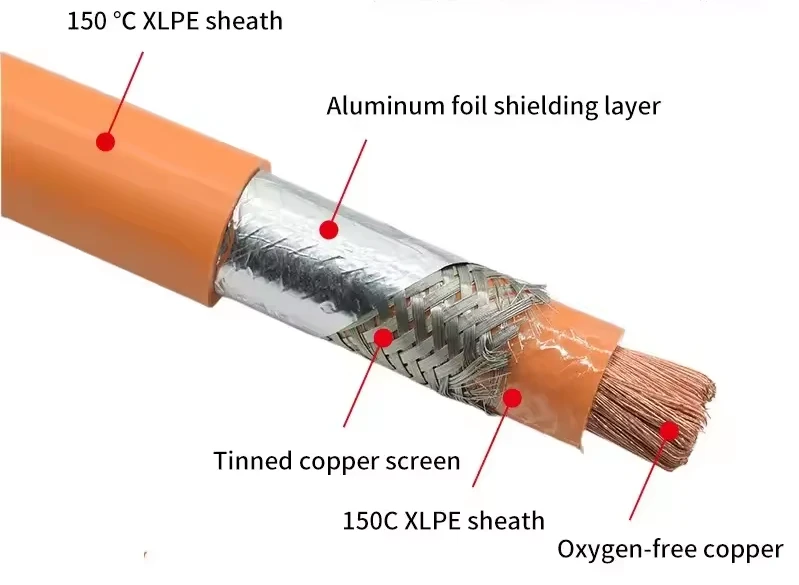
The New energy EV cable for vehicle charging possesses various key features and primarily utilizes silicone as its insulating material. Silicone exhibits excellent heat resistance and resistance to acids and alkalis, maintaining good flexibility and stability even in extremely high temperatures or harsh environments. It also has the characteristics of low-smoke, halogen-free flame retardancy, ensuring that no toxic gases are released, and large amounts of smoke are not generated even in the event of a fire, thus ensuring safe usage.
The rated voltage of this cable can reach up to 1500VDC, making it suitable for power transmission requirements in high-voltage environments, providing reliable and efficient power transfer. The insulation material, rated voltage, and temperature resistance characteristics ensure safe and reliable use during the charging process. This cable, with its multiple features, meets the requirements of modern electric vehicle charging systems for high performance, safety, and reliability, providing the necessary power support for electric vehicle charging. With a wide temperature range, it can operate in extreme cold conditions as low as -40 degrees Celsius and up to high temperatures of 180 degrees Celsius, maintaining stability and reliability. This enables the cable to function normally in various climates and environmental conditions, adapting to different extreme temperature situations.
This new energy storage cable is widely used in various fields such as photovoltaic energy storage, communication base station energy storage, mobile energy storage, shared energy storage, aviation, automotive, marine, industrial, And energy.


Products Description
Below are some of the parameters for New energy EV cable , for more information, please contact us.(cable3@sxjshsm.com)
|
Type |
Conductor |
Insulation |
Jacket |
Max.cond. Resistance |
|||
|
EV Shielded Cable |
mm2 |
Construction (No./mm) |
OD (mm) |
Shielded |
Material |
OD (mm) |
(Ω/Km,20ºC,Dc)
|
|
0.5 |
16/0.20 |
2.90 |
Shield braid |
AL-Mylar |
5.50 | 37.1 | |
|
0.75 |
24/0.20 |
3.10 |
Shield braid |
AL-Mylar |
5.70 |
24.2 |
|
|
1.0 |
32/0.20 |
3.70 |
Shield braid |
AL-Mylar |
6.30 |
18.5 |
|
| 1.5 |
49/0.20 |
4.00 |
Shield braid |
AL-Mylar |
6.60 | 12.7 | |
| 2.0 |
64/0.20 |
4.10 |
Shield braid |
AL-Mylar |
6.80 |
9.42 |
|
|
2.5 |
79/0.20 |
4.30 |
Shield braid |
AL-Mylar |
7.00 |
7.60 |
|
|
3.0 |
7/14/0.20 |
4.90 |
Shield braid |
AL-Mylar |
7.50 |
6.15 |
|
| 4.0 |
7/18/0.20 |
5.20 |
Shield braid |
AL-Mylar |
7.80 |
4.71 |
|
|
|
5.0 |
7/23/0.20 |
5.40 |
Shield braid |
AL-Mylar |
8.00 |
3.70 |
|
6.0 |
7/27/0.20 |
5.60 |
Shield braid |
AL-Mylar |
8.30 |
3.14 |
|
|
8.0 |
7/37/0.20 |
6.50 |
Shield braid |
AL-Mylar |
9.30 |
2.52 |
|
Application
The application of New Energy EV cables spans various sectors and scenarios, enhancing the charging infrastructure for electric vehicles (EVs) through advanced technology and smart features. Here's a detailed look at their applications:
1. Residential Charging
Home Charging Stations: New Energy EV cables are used with residential charging units, enabling EV owners to charge their vehicles conveniently at home. These cables are often integrated with smart home systems for optimized energy use.
Portable Chargers: These cables can be part of portable charging solutions, allowing for flexible and convenient home charging setups.
2. Public Charging Infrastructure
Public Charging Stations: Deployed in parking lots, shopping centers, and other public areas, providing accessible charging options for EV owners.
Fast Charging Stations: Equipped with high-power New Energy EV cables, these stations offer rapid charging capabilities, reducing the time needed to charge an EV significantly.
3. Commercial and Industrial Applications
Fleet Charging: Used in charging stations for fleets of electric vehicles such as delivery vans, taxis, and company cars, ensuring efficient and coordinated charging to keep the fleet operational.
Workplace Charging: Installed at office complexes and business parks, allowing employees to charge their EVs during working hours, often integrated with energy management systems to balance load during peak hours.
4. Highway and Long-Distance Travel
Highway Charging Stations: Located along highways and major travel routes, these stations use high-power New Energy EV cables to support long-distance travel by providing fast charging options, minimizing downtime during travel.
5. Public and Private Transportation
Electric Buses and Trucks: Specialized high-capacity cables are used for charging electric buses and trucks, supporting the electrification of public transport and logistics.
Airport and Port Charging: Deployed in airports and ports for charging electric ground support equipment and vehicles.
6. Renewable Energy Integration
Solar-Powered Charging Stations: These charging stations utilize New Energy EV cables in conjunction with solar panels to offer sustainable and eco-friendly charging solutions.
Vehicle-to-Grid (V2G) and Vehicle-to-Home (V2H): New Energy EV cables enable bi-directional charging, allowing EVs to supply power back to the grid or home during peak demand periods, contributing to energy management and grid stability.
7. Wireless and Inductive Charging
Wireless Charging Pads: Used in inductive charging systems that eliminate the need for physical cables, providing a seamless and convenient charging experience for EV owners.
Dynamic Charging Systems: Advanced applications where vehicles are charged wirelessly while in motion, typically used in specific lanes on highways.
8. Emergency and Remote Charging Solutions
Portable Charging Units: Mobile charging solutions equipped with New Energy EV cables, useful in emergency situations or remote locations where fixed infrastructure is not available.
9.Mobile Charging Services: On-demand charging services that bring the charger to the vehicle, often using trucks equipped with high-power New Energy EV cables.
Our factory & quipment


FAQ
Here's a comprehensive FAQ for the New Energy EV Cable:
Frequently Asked Questions (FAQ) for New Energy EV Cable
1. What is a New Energy EV Cable?
A New Energy EV Cable is an advanced charging cable designed for electric vehicles (EVs), optimized for efficient, reliable, and safe power transfer. These cables support various charging standards and power levels, incorporating modern materials and smart technologies.
2. What are the key features of New Energy EV Cables?
High-Power Delivery: Supports rapid and ultra-fast charging.
Advanced Materials: Uses high-grade copper or aluminum for conductors and durable polymers for insulation.
Thermal Management: Includes cooling systems to manage heat dissipation.
Smart Features: Integrates communication protocols for smart charging and load balancing.
Durability: Resistant to environmental factors like UV radiation, chemicals, and extreme temperatures.
3. What types of connectors are available for these cables?
Type 1 (SAE J1772): Common in North America, single-phase AC charging.
Type 2 (Mennekes): Standard in Europe, supports single-phase and three-phase AC charging.
CHAdeMO: Used primarily in Japan and some other regions, supports high-power DC charging.
CCS (Combined Charging System): Includes CCS1 (North America) and CCS2 (Europe), supporting both AC and DC charging.
GB/T: Standard in China for DC fast charging.
4. What are the typical applications of New Energy EV Cables?
Residential Charging: Home charging stations and portable chargers.
Public Charging Infrastructure: Public and fast charging stations in parking lots and public spaces.
Commercial and Industrial Applications: Fleet and workplace charging.
Highway and Long-Distance Travel: Highway charging stations for rapid charging during travel.
Public and Private Transportation: Charging for electric buses, trucks, and airport/port vehicles.
Renewable Energy Integration: Solar-powered charging stations and bi-directional charging for vehicle-to-grid (V2G) applications.
Wireless and Inductive Charging: Wireless charging pads and dynamic charging systems.
5. How do these cables ensure safety?
Compliance with Standards: Adheres to international standards like IEC 62196 and ISO 17409.
Safety Features: Overcurrent protection, ground fault detection, and waterproofing.
Durable Design: Built to withstand harsh environmental conditions and heavy usage.
6. What is the difference between AC and DC charging with these cables?
AC Charging: Typically uses Type 1 or Type 2 connectors, suitable for home and workplace charging with power levels up to 22 kW.
DC Charging: Uses connectors like CHAdeMO, CCS, or GB/T, suitable for public fast charging stations with power levels up to 350 kW or more, enabling much faster charging.
7. Can these cables be used with smart charging systems?
Yes, New Energy EV Cables can be integrated with smart charging systems that use communication protocols like ISO 15118. This allows for features like smart energy management, load balancing, and vehicle-to-grid (V2G) capabilities.
8. What length of cable should I choose?
Cable length varies based on usage scenarios. Common lengths range from 2 to 10 meters. For home use, shorter cables (2-5 meters) are typically sufficient, while longer cables (5-10 meters) may be needed for public or commercial applications.
9. Are these cables weather-resistant?
Yes, New Energy EV Cables are designed to be weather-resistant, with high protection ratings (IP65 or higher) to withstand outdoor elements like rain, dust, and extreme temperatures.
10. What innovations are being developed for these cables?
Wireless Charging: Inductive charging systems that eliminate the need for physical cables.
Bi-Directional Charging: Enabling vehicles to feed power back into the grid or home.
Sustainable Materials: Use of eco-friendly materials in man
Contact us
For more information about New energy EV cable for vehicle charging.please contact us;
Phone number : +8618802926539
Email address: Cable3@sxjshsm.com
Whatsapp number: +8618802926539
Hot Tags: new energy ev cable for vehicle charging, China new energy ev cable for vehicle charging manufacturers, suppliers, High Voltage Cables For Electric Vehicles, Automotive Shielded EV Cable, New Energy Electric Car Charging Cable, Electric Vehicle Power Cable, High Voltage Electric Vehicle Charging Cable